

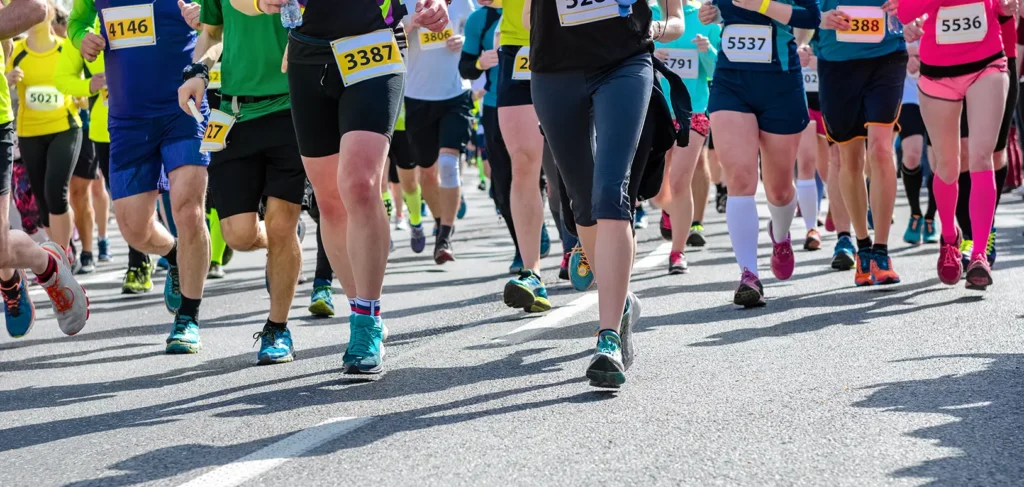
Crossing the finish line of a marathon is a huge achievement. But while race day may be over, your body’s work is only just beginning.
A marathon places significant stress on your muscles, tendons, immune system, and nervous system. Many runners feel ready to train again within a few days – but internally, recovery takes far longer than soreness alone suggests.
At Great Northern Physiotherapy, we regularly help runners navigate the post-race period properly. Recover well, and you return stronger. Rush it, and you risk injury, fatigue, and prolonged setbacks.
Here’s how to approach marathon recovery using both practical experience and the latest research.
Why Marathon Recovery Matters
A marathon causes:
- Microscopic muscle fibre damage (tiny tears in the muscles from hard effort)
- Elevated inflammation (the body’s natural repair response causing soreness and swelling)
- Tendon and connective tissue stress (strain on tendons, ligaments, and supporting tissues)
- Glycogen depletion (low stored energy levels in the muscles)
- Nervous system fatigue (the brain and body feeling drained and slow to respond)
- Temporary immune suppression (your immune system is slightly lowered for a short time after the race)
A 2021 review on post-marathon recovery found that while glycogen stores may recover within 48–72 hours, muscle damage and inflammation markers can remain elevated for 7 days or more, with full structural recovery often taking 2–4 weeks (Vatne et al., 2025).
That means feeling “okay” does not necessarily mean you’re recovered.
Phase 1: The First 24 Hours
Keep Moving
After finishing, avoid collapsing straight onto the grass.
Instead:
- Walk for 10–15 minutes
- Keep blood circulating
- Gradually lower heart rate
- Reduce stiffness setting in
Refuel Immediately
Within the first hour aim for:
- Carbohydrate + protein snack
- Around a 3:1 carbohydrate-to-protein ratio
- Fluids plus electrolytes
Research on endurance recovery nutrition shows combining carbohydrate with protein enhances glycogen replenishment and supports muscle repair more effectively than carbohydrate alone (Moore, 2015).
Phase 2: Days 1–3
Expect DOMS (Delayed Onset Muscle Soreness). This is usually the toughest part.
Walking downstairs hurts. Sitting down hurts. Everything feels stiff.
That’s normal.
Best Strategy: Active Recovery Research comparing active recovery to complete rest suggests light movement is superior for restoring function and reducing soreness (Perrier-Melo et al., 2021).
Good options include:
- Walking
- Gentle cycling
- Easy swimming
- Mobility work
- Light yoga Avoid:
- Hard stretching
- Running
- Intense gym sessions Look After Your Immune System
Heavy endurance events can temporarily suppress immune function – this is known as the “open window”.
For a few days post-race:
- Prioritise sleep
- Eat well
- Hydrate
- Reduce stress
- Avoid obvious illness exposure where possible
Phase 3: Days 4–7
Begin Reintroducing Movement
By now soreness usually improves – but tissue repair is still ongoing. A study tracking marathon runners found:
- Heart stress markers normalised around 4 days
- Creatine kinase (muscle damage marker) around 6 days
- Other markers remained elevated for 8+ days (Bester et al, 2023) So while you may feel ready, your body may still be recovering internally.
Can You Run Yet?
Possibly—but gently.
Try a short 15–30 minute easy test run only if:
- Walking is pain free
- Stairs feel normal
- No sharp niggles
- Energy levels are good
Keep effort truly easy: Comfortable, controlled, conversational.
Stop if anything feels wrong.
Massage?
A sports massage around day 3–5 can be beneficial once acute soreness settles. Research suggests massage may reduce post-race muscle soreness by up to 30%, improve flexibility and range of motion, enhance circulation, and support perceived recovery (Sriwongtong et al., 2020). While it is unlikely to directly improve strength or performance immediately, it can be a valuable tool for reducing stiffness, aiding relaxation, and helping you feel ready to train again.
Phase 4: Weeks 2–4
The Reverse Taper
Think of recovery like a taper in reverse. Instead of jumping back to full mileage, gradually rebuild over 3–4 weeks (Vatne et al., 2025).
Example Return:
Week 2
- 3–4 short easy runs
- Low total mileage
- Optional cycling/swim
Week 3
- Increase run duration gradually
- Maintain easy intensity
Week 4
- Resume more normal structure
- Introduce moderate sessions if recovered
The “One Day Per Mile” Rule
Many coaches use the traditional guideline: One day of no hard training for every mile raced.
For a marathon: Approximately 26 days before racing or high intensity sessions again
For a half marathon: Around 13 days before racing or high intensity sessions again
It’s conservative – but for many runners, sensible.
Common Mistakes We See
- Returning Too Soon – Feeling mentally fresh often arrives before physical readiness.
- Chasing Fitness Immediately – You won’t lose your marathon fitness in a week.
- Ignoring Niggles – Post-race niggles often become tendon problems if pushed through.
- Running Every Session Too Hard – Early runs should be easy aerobic efforts only.
Need Help Recovering From a Marathon?
Recovery is where adaptation happens. The race breaks you down; recovery builds you back stronger. Respect the process and your next training block will thank you for it.
At Great Northern Physiotherapy, we help runners with:
- Post-marathon niggles & injuries
- Sports massage to facilitate recovery
- Running gait analysis
- Strength and Return-to-training programming If something doesn’t feel right after race day, don’t wait for it to become a bigger issue.
Get assessed early and recover properly.
References
Bester, R., Stander, Z., Mason, S., Keane, K.M., Glyn Howatson, Clifford, T., Stevenson, E. and Du Toit Loots (2023). The metabolic recovery of marathon runners: an untargeted 1H-NMR metabolomics perspective. Frontiers in Physiology, 14. doi:https://doi.org/10.3389/fphys.2023.1117687.
Moore, D.R. (2015). Nutrition to Support Recovery from Endurance Exercise. Current Sports Medicine Reports, [online] 14(4), pp.294–300. doi:https://doi.org/10.1249/jsr.0000000000000180.
Perrier-Melo, R.J., D’Amorim, I., Meireles Santos, T., Caldas Costa, E., Rodrigues Barbosa, R. and da Cunha Costa, M. (2021). Effect of active versus passive recovery on performance-related outcome during high-intensity interval exercise. The Journal of Sports Medicine and Physical Fitness, 61(4). Doi: https://pubmed.ncbi.nlm.nih.gov/32744041/
Sriwongtong, M., Goldman, J., Kobayashi, Y. and Gottschalk, A.W. (2020). Does Massage Help Athletes After Exercise? Ochsner Journal, 20(2), pp.121–122. doi:https://doi.org/10.31486/toj.20.0008.
Vatne, E., Oliva-Lozano, J.M., Saenz, C., Cost, R. and Hagen, J. (2025). Post-Exercise Recovery Modalities in Male and Female Soccer Players of All Ages and Competitive Levels: A Systematic Review. Sports, [online] 13(10), p.343. doi:https://doi.org/10.3390/sports13100343.

