
A meniscus injury can make ordinary movements feel uncertain. You may notice pain when twisting, swelling after activity, difficulty with stairs or a knee that does not feel as reliable as it did before. If you are trying to return to exercise, it is understandable to wonder whether strengthening will help or whether certain movements could make things worse.
In many cases, rehabilitation involves gradually restoring strength, movement and confidence rather than avoiding activity indefinitely. The right approach depends on your symptoms, how the injury happened, your previous activity levels and whether you have had surgery. An assessment can help establish what your knee is currently able to tolerate and how to progress safely.
What does the meniscus do?
The menisci are two crescent-shaped pieces of cartilage inside the knee. They help distribute load between the thigh bone and shin bone and contribute to the knee’s stability and movement.
A meniscal problem can happen after a twisting injury, particularly during sport, but symptoms can also develop gradually. Not every meniscal change causes pain, and the presence of a tear on a scan does not always explain every symptom. This is one reason why a physical assessment and discussion of your goals are important when planning rehabilitation.
Some people experience:
- Pain around the inside or outside of the knee
- Swelling after activity
- Discomfort with squatting, kneeling or twisting
- A catching sensation
- Reduced confidence when changing direction
- Difficulty fully bending or straightening the knee
These symptoms can vary considerably. A rehabilitation programme should be based on your presentation rather than on the scan report alone.
Why is strength important?
Pain and swelling can cause you to reduce how much you use the affected leg. You may start avoiding stairs, walking differently or putting more weight through the other side. Over time, this can reduce strength and make normal tasks feel harder.
Strength work can help you rebuild the capacity needed for everyday and sporting movements. The aim is not simply to make one muscle stronger. It is to improve how your hip, thigh, knee and calf work together while gradually increasing the amount of load your knee can manage.
Strength can support:
- Getting up from a chair
- Walking comfortably
- Using stairs
- Controlling a squat or lunge
- Returning to running or field sports
- Feeling more secure during changes of direction
The most useful exercises are not necessarily the most advanced. A well-chosen exercise that you can perform consistently and confidently is often a better starting point than a difficult movement that repeatedly aggravates your symptoms.
Start with the movement you can control
Early rehabilitation may focus on comfortable movement and reintroducing load in a manageable way. Depending on your symptoms, this could include exercises such as:
- Gentle knee bends within a comfortable range
- Straightening the knee while seated or lying down
- Sit-to-stand practice from a suitable chair height
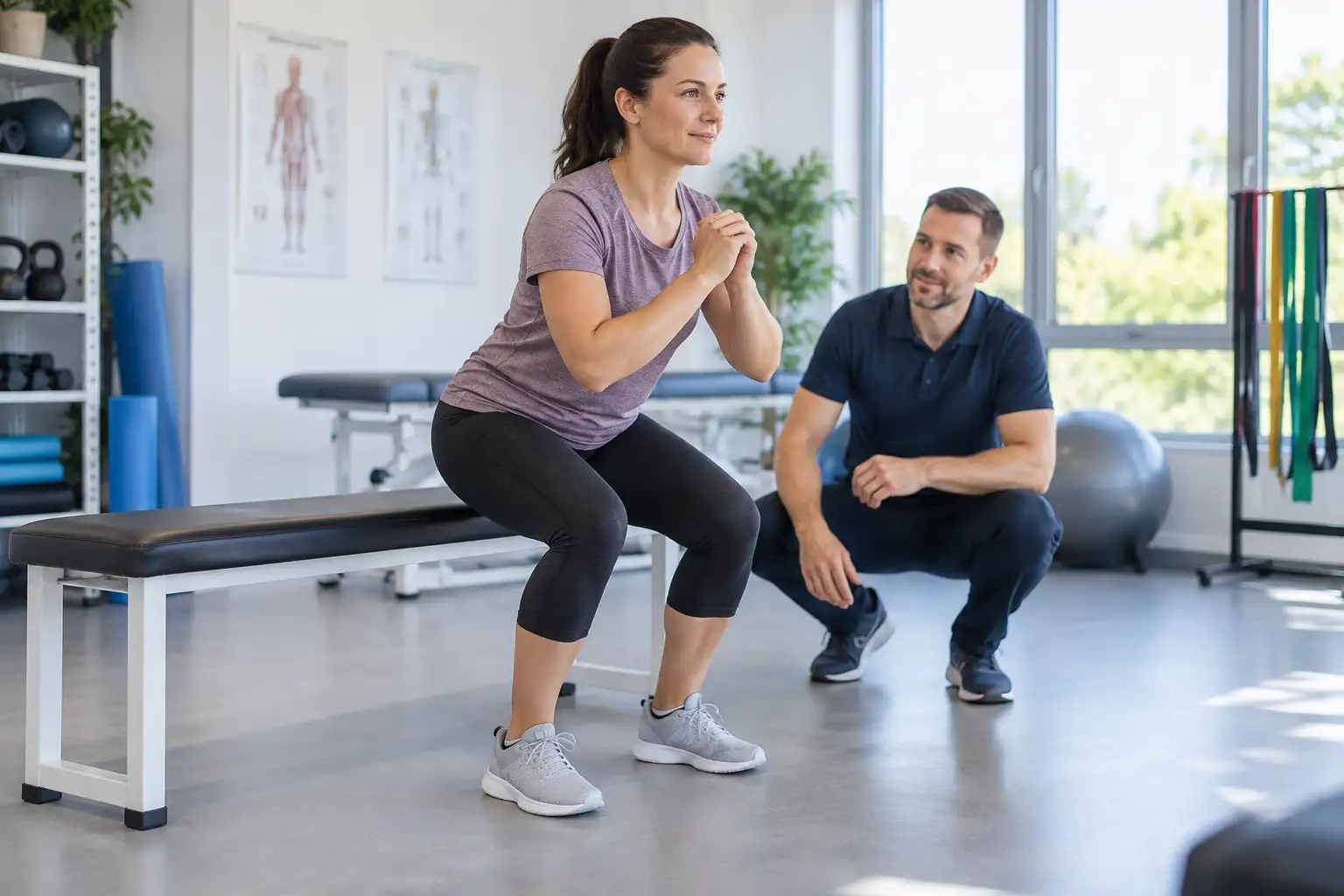
- Supported mini-squats
- Controlled step-ups
- Bridges or hip-strengthening exercises
- Calf raises
- Balance work while holding a stable surface
The exact choice, range and number of repetitions should be adapted to you. If bending deeply is uncomfortable, you may begin with a smaller movement. If single-leg exercises feel uncertain, you may start with both feet supported.
The goal is to practise good-quality movement without forcing the knee into pain or repeatedly provoking swelling. Over time, the exercise can become more demanding by changing the range, resistance, speed, balance requirements or number of repetitions.
Gradual loading matters
A knee may tolerate one level of activity but struggle when several demands increase at once. For example, returning to longer walks, hills, heavy gym exercises and twisting sports in the same week may provide more load than the knee is ready to manage.
Gradual loading means changing one or more parts of the activity in a planned way. You might:
- Begin with a comfortable number of repetitions.
- Repeat the exercise consistently.
- Check how your knee responds later that day and the following morning.
- Increase the challenge only when the current level feels manageable.
- Reduce or modify the load if symptoms become more irritable.
A small amount of discomfort does not automatically mean that damage is occurring, but worsening pain, increasing swelling or a clear loss of movement may suggest that the current dose is too much. Your response over the next 24 hours can be useful information when deciding whether to progress.
This does not mean that every session must feel exactly the same. Recovery, sleep, work demands and other training will all affect how your knee responds. A flexible plan is usually more practical than a rigid programme that ignores changes from day to day.
Rebuilding movement confidence
Strength and confidence often develop together. After a painful twist or a period of reduced activity, you may feel cautious even when the knee is physically capable of more. This can lead to guarded movement, avoiding certain positions or constantly checking the knee.
Confidence is not built by forcing yourself into movements that feel threatening. It usually improves through repeated, controlled experiences of movement going well. A physiotherapist may help you break a difficult task into smaller steps, such as:
- Standing from a higher chair before using a lower one
- Practising a supported squat before progressing to a deeper range
- Using a step-up before attempting stairs quickly
- Walking on a flat surface before adding uneven ground
- Introducing gentle changes of direction before returning to sport
This approach gives you an opportunity to learn what your knee can do now, while creating a clear route towards what you want to do next.
Returning to sport or higher-level activity
If your goal is running, football, racket sport, skiing or another activity involving impact and rotation, basic strength is only one part of the preparation. You may also need to rebuild:
- Single-leg control
- Balance and coordination
- Calf and hip strength
- The ability to decelerate
- Hopping or landing capacity
- Repeated-effort tolerance
- Confidence changing direction
Your return should reflect the demands of your activity. A person returning to recreational cycling will have different requirements from someone returning to a sport involving sprinting, jumping and rapid pivots.
A gradual return may begin with shorter sessions, lower intensity or fewer changes of direction. It is sensible to increase only one or two variables at a time and monitor how your knee responds. Previous fitness does not always equal current tissue capacity, particularly after a period of reduced training.
When should you seek an assessment?
Consider arranging an assessment if knee symptoms are not settling, are limiting work or exercise, or are making you unsure how to move forwards. A physiotherapist can review your history, examine your knee and help determine whether rehabilitation is appropriate or whether further investigation should be considered.
Seek timely medical advice if your knee is persistently locked, you cannot bear weight, there is substantial swelling after an injury, or you have significant loss of movement. If you have had surgery, follow the specific guidance provided by your surgical and rehabilitation team, as the timing and restrictions may differ.
Imaging can sometimes be useful, but it is not always the first step for every knee problem. The decision should be guided by your symptoms, examination findings and how the information would change your management.
A practical way to think about recovery
Meniscus rehabilitation is not about proving that you can tolerate as much as possible as quickly as possible. It is about developing capacity in stages.
A useful progression may look like this:
- Settle and understand: identify aggravating activities and allow symptoms to become more manageable.
- Restore movement: work towards comfortable bending and straightening.
- Build basic strength: practise controlled exercises using an appropriate range.
- Increase capacity: add resistance, repetitions, single-leg work or more demanding positions.
- Rehearse your goals: introduce walking, running, lifting or sport-specific movements gradually.
- Maintain progress: continue strength work even after everyday symptoms have improved.
There may be setbacks along the way. A flare-up does not necessarily mean that rehabilitation has failed, but it may be a sign to review the recent increase in activity and temporarily return to a more manageable level.
The most effective plan is one that fits your symptoms, your responsibilities and the activities that matter to you. With appropriate guidance, strengthening can help you move from protecting the knee to using it with greater capability and confidence.
Strengthening is often an important part of rehabilitation, but the exercise, range and load need to match your current tolerance. Exercises that repeatedly increase swelling, pain or loss of movement may need to be modified. A physiotherapist can help you choose suitable starting points and progress them safely.
The timeframe varies according to the nature of the problem, your starting strength, symptoms, activity goals and whether surgery has taken place. Progress is usually measured through improving movement, tolerance and function rather than a fixed timetable.
Not necessarily. Squatting may need to be modified initially by changing the depth, load, speed or support available. Avoiding all knee-bending movements for a prolonged period can make it harder to rebuild capacity. Your assessment can help identify a comfortable and useful starting range.
Many people can work towards running, but the appropriate timing depends on symptoms, strength, control and the demands of your injury and activity. A gradual return should include monitoring your response to impact and increasing running load progressively.
Book an appointment
If knee symptoms are limiting your movement or you are unsure how to progress your rehabilitation, book an appointment with Great Northern Physiotherapy. You can self-refer for an assessment and discuss the most appropriate next steps for your recovery.
Book an appointment, call 01522 787164 or email hello@greatnorthernphysiotherapy.co.uk.
Related Services
Related Articles
-

Load With Purpose: Why Gradual Loading Matters for Performance & Injury Prevention
Whether you’re rehabbing after an injury or pushing toward your next performance goal, how you load your body matters. The body adapts – but only if you dose load just right. Too little and you don’t trigger adaptation; too much and you risk damage, setbacks or injury. In other words, successful training or rehabilitation isn’t…
-

How to Build a Safe Return-to-Sport Plan After Injury
Returning to sport after injury is a process, not a single test. Learn how to use rehabilitation milestones, gradual load progression and confidence to plan your way back safely.