
What Can Athlete Testing Tell You That Training Data Cannot?
Most athletes now have access to more training information than ever before. A watch can record pace, distance, heart rate and elevation. A cycling computer can show power, cadence and time in different zones. Training platforms can bring these numbers together and help you monitor patterns over weeks or months.
That information can be extremely useful. It helps you understand what you have done and how your training is progressing.
But there is another question that wearable data may not answer:
How is your body producing that performance?
This is where structured athlete testing can add value. Biomechanical and physiological assessments do not replace your training data. Instead, they can help explain it by examining movement, force, efficiency and response under controlled conditions.
Training data tells you what happened
Wearable technology is particularly useful for tracking the external demands of training. Depending on your sport and equipment, this may include:
- Distance covered
- Pace or speed
- Heart rate
- Power
- Cadence
- Elevation
- Duration
- Time spent in different training zones
- Session frequency and consistency
For example, your watch may show that you completed a 10-kilometre run at a particular average pace and heart rate. Over time, you may notice that your pace is improving, or that the same pace feels easier.
This is valuable information. It can help you manage training load, plan sessions and identify changes in general fitness.
However, these metrics are mostly an account of the session itself. They do not necessarily show whether you were favouring one leg, losing force as you became tired, using more oxygen than expected or moving differently on one side of your body.
A wearable may tell you that your performance changed. It may not tell you why.
Structured testing looks at the process behind performance
Athlete testing is designed to investigate specific questions. Rather than simply collecting data during normal training, a structured assessment uses repeatable tasks and agreed measures to explore how you move or respond to exercise.
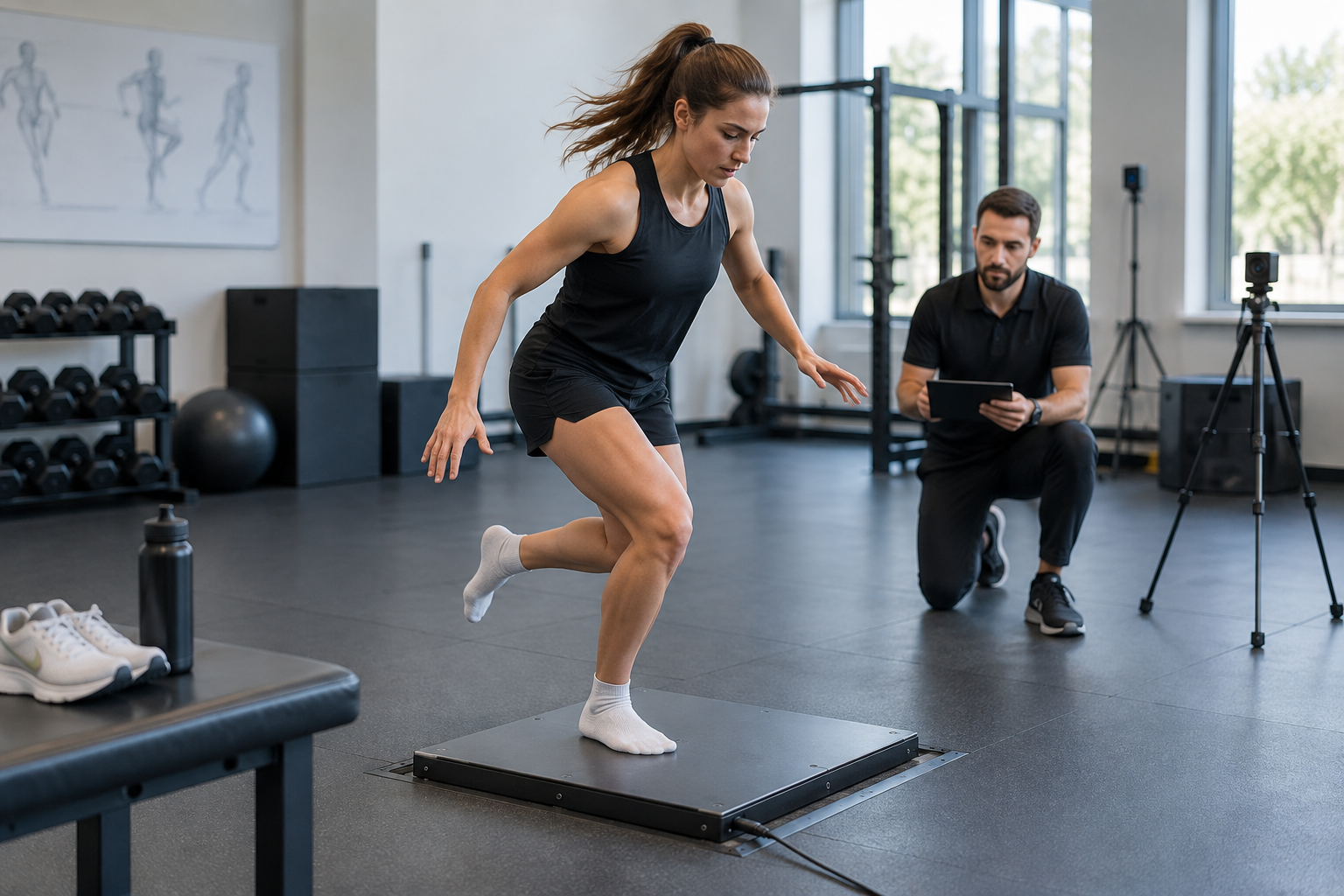
At the Great Northern Physiotherapy Performance Lab, testing can include biomechanical assessment, movement sensors, force plate testing, video gait analysis and muscle oxygen testing. The most appropriate assessment depends on your sport, current training and goals.
The results may help identify:
- Differences in force between limbs
- Changes in movement quality
- Potential inefficiencies in running or other sporting actions
- How you respond to a particular exercise intensity
- Training zones or thresholds that can guide endurance work
- Whether a rehabilitation programme is producing measurable change
The important point is that testing should lead to a useful decision. More numbers are not automatically better. The purpose is to understand what the information means and how it could influence your training.
What can biomechanical testing reveal?
Biomechanical testing examines how your body moves and produces force. This can be relevant to runners, triathletes, Hyrox and hybrid athletes, as well as people returning to sport after injury.
1. How you distribute force
Two athletes may complete the same squat, jump or running session, but they may distribute load differently through their body.
Force plate testing can provide objective information about how much force is produced and how that force is applied. It may also highlight differences between the left and right sides.
A difference does not automatically mean that you are injured or that something is wrong. Bodies are not perfectly symmetrical, and the significance of a finding depends on the task, your history and your symptoms.
The benefit is that a measured difference can become a point for discussion and, where appropriate, targeted strength or movement work.
2. What happens when you run
Video gait analysis and movement sensors can help examine aspects of running technique that are difficult to judge from feel alone.
You may feel that your stride is smooth, yet a structured assessment could identify changes in loading, timing or movement between sides. Alternatively, you may be worried about a perceived fault that is not actually limiting your performance.
This can be particularly useful when:
- You are increasing mileage
- You are preparing for a race
- You have recurring symptoms
- You are returning to running after injury
- Your performance has plateaued
- You want to understand how your movement changes under demand
Testing does not provide a magic running style that everyone should copy. It provides information about your own movement in a particular context.
3. Whether rehabilitation is changing measurable capacity
Pain and confidence are important parts of recovery, but they are not the only things worth monitoring.
If you have been working on strength, control or power after an injury, repeat testing may show whether your physical capacity has changed. This can support conversations about progressing training, modifying exercises or returning to a specific sporting demand.
Again, a single result should not be treated as a pass-or-fail verdict. Progress is better understood alongside symptoms, function, training tolerance and your goals.
What can physiological testing reveal?
Physiological testing focuses on how your body responds to exercise. It can be useful when you want to make endurance training more individual rather than relying entirely on generic pace or heart-rate guidance.
For example, two runners may be told to complete an “easy” session at the same pace. Their actual physiological response may be different because of their current fitness, training background, fatigue or other factors.
A structured physiology assessment can help explore:
- How your heart rate responds as intensity changes
- How efficiently your muscles use oxygen
- Where training zones or thresholds may sit
- Whether your current sessions match your intended effort
- How your response changes over time
This does not mean every session needs laboratory-style precision. In many cases, simple effort-based guidance is perfectly appropriate. Testing may become more useful when you are training consistently but feel unsure whether your zones are accurate, or when you need to make better use of limited training time.
For runners, cyclists and hybrid athletes, clearer physiological information can help distinguish between sessions designed to build endurance, improve speed or develop strength-endurance.
Why your wearable and test results may not agree
It is common to expect every data source to tell the same story. In reality, differences can occur for several reasons:
- Devices use different sensors and algorithms
- Conditions vary between training and testing
- Fatigue, sleep, stress and hydration can affect performance
- A watch may estimate some values rather than measure them directly
- Your body may respond differently to different modes of exercise
- A short structured test is not the same as a long training session
A disagreement is not necessarily a problem. It may be a reason to review how the information was collected and what question each measure is answering.
The aim is not to decide that one source is always “right”. It is to use the most appropriate information for the decision you need to make.
When might athlete testing be worthwhile?
Testing may be worth considering if you recognise one or more of these situations:
You are training hard but not progressing
If your training is consistent and your effort is high but performance has stalled, assessment may help identify whether the limitation relates to pacing, movement, strength, physiological capacity or recovery.
You are returning from injury
Objective measures can provide another way to track progress alongside pain, confidence and sporting function. This may be useful when deciding how to increase load or reintroduce higher-speed work.
You are preparing for a specific event
A race or competition can provide a clear reason to understand your current strengths and limitations. Testing may help you make your training more specific rather than simply adding more volume.
You suspect an imbalance
If one side feels weaker, you repeatedly develop symptoms or a movement feels inconsistent, structured assessment can help investigate the issue. It should form part of a wider assessment rather than being interpreted in isolation.
You are unsure how to use your data
A large amount of information can create confusion. A testing session with professional interpretation may help you decide which metrics matter for your goal and which can be ignored.
When testing may not be necessary
Not every athlete needs formal testing. If you are enjoying your training, progressing steadily and have no specific question to answer, your existing training information may be enough.
Testing is also not a guarantee against injury or a substitute for sensible progression, recovery, nutrition and coaching. A result is only useful when it is interpreted in context and translated into an appropriate plan.
The best starting point is a clear question, such as:
- Why does my left side feel different when I run?
- Are my current training zones suitable for my goal?
- Have I regained enough strength to progress after injury?
- Why am I working hard without seeing the improvement I expected?
- What should I prioritise over the next phase of training?
The practical difference
In simple terms:
- Training data describes the session.
- Biomechanical testing examines how you move and produce force.
- Physiological testing examines how your body responds to exercise.
- Professional interpretation connects the findings to your next decision.
You do not have to choose between wearable data and structured testing. Used together, they can provide a more complete picture of performance.
Your watch might show that your pace slowed during the final part of a run. A biomechanical assessment may help explore whether your movement or force production changes when fatigued. Physiological testing may help determine whether the intensity was appropriate for the session you intended to complete.
That additional context can make training more purposeful.
No. Structured testing can be useful for recreational runners, new triathletes and hybrid athletes, particularly when they have a specific training or performance question. The appropriate level of assessment depends on your goals and experience.
No test can guarantee that an injury will or will not occur. Testing may identify factors worth addressing, such as differences in strength, movement or training response, but these findings need to be considered alongside your history, symptoms and training load.
No. Wearable data can remain useful for monitoring training and recovery. Testing adds a different type of information rather than making your existing device irrelevant.
There is no universal schedule. A repeat assessment may be useful after a meaningful period of training, rehabilitation or preparation, particularly when you want to check whether a specific measure has changed. The timing should relate to your question and goals.
Related Services
Related News / Insights / Articles / Blog
- Elevate Your Training: Understanding the Performance Lab
- Load With Purpose: Why Gradual Loading Matters for Performance & Injury Prevention
Not sure whether testing could help?
Start with a conversation about your training, symptoms and goals. Book a Compass Clinic session to determine which level of Performance Lab to try or if a more specific assessment is appropriate.